From undergraduate research to pioneering aviation solutions
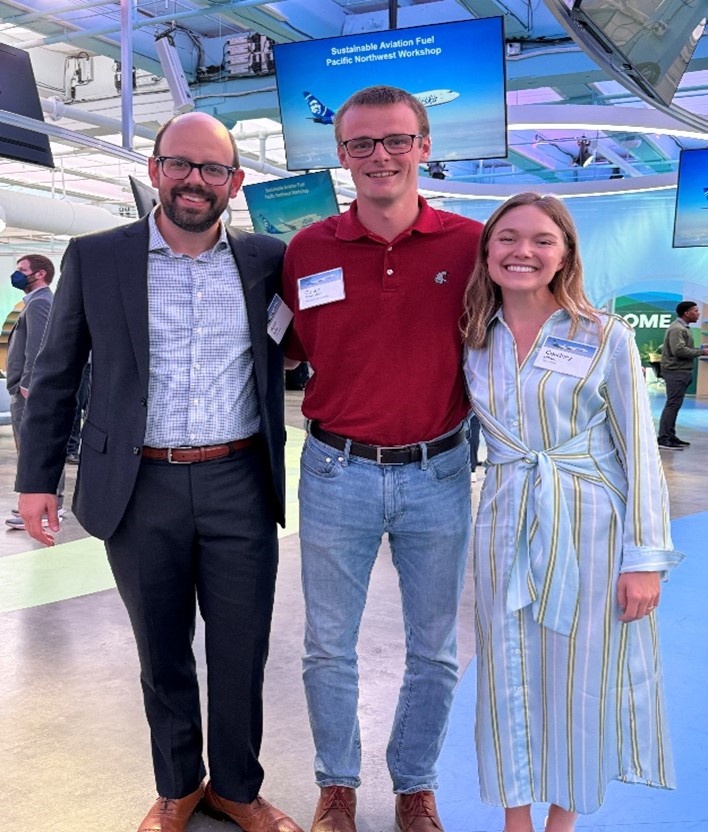
When Conor Faulhaber completed his undergraduate degree at the University of Dayton in Ohio, he knew he wanted to find a graduate program that focused on alternative jet fuels (AJFs). However, he never imagined it would lead him to Washington state.
While completing his undergraduate research, he received mentorship from Joshua Heyne. Shortly before Faulhaber graduated, Heyne moved out west and joined Washington State University as the director of the Bioproducts, Sciences, and Engineering Lab (BSEL) and the co-director of the WSU-Pacific Northwest National Laboratory (PNNL) Bioproducts Institute (Bio-In). Heyne hired Faulhaber as an intern at BSEL that same summer.
“I had a unique pathway to my graduate program. Before graduating from the University of Dayton, I took an internship in summer 2022 at BSEL working with Josh Heyne, who had previously been my undergraduate research advisor,” said Faulhaber.
Through the internship and Heyne’s work with the Bio-In, Faulhaber learned about the WSU-PNNL Distinguished Graduate Research Program (DGRP), which provides academic learning through WSU and real-world hands-on Department of Energy (DOE) national laboratory experience through PNNL.
“During the internship, I explored the idea of graduate school at WSU,” he said. “I found the opportunity to work with researchers and gain professional experience in the DOE national lab while being in graduate school especially appealing.”
Following graduation, Faulhaber applied and was accepted into the graduate program at WSU Tri-Cities. Now he’s part of the DGRP, and once again Heyne is one of his advisors and he is also working with Mike Thorson and Huamin Wang at PNNL.
“The DGRP has allowed me to learn from outstanding professors at WSU and PNNL researchers. Not only am I getting real-world experience in a DOE national laboratory, but I’m also creating connections that will provide career opportunities going forward,” said Faulhaber.
Faulhaber’s graduate research is focused on AJFs, specifically looking at low levels of nitrogen and the role it plays in thermal stability of AJF. “If we understand how much nitrogen can be in the fuel and how it impacts fuel stability, then we can inform the producers on their production process to optimize both costs and renewable carbon,” said Faulhaber.
Companies or DOE national laboratories send AJFs to BSEL and Bio-In for property testing. As part of the DGRP, Faulhaber is working with researchers in the lab to test and provide data that determines whether the fuel sample will work in a current aircraft fleet.
“As the technology for AJF has advanced, producers are getting good at making the bulk fuel properties correct. This includes making sure the fuel has the right density, viscosity, and freeze point,” said Faulhaber. “We are now studying smaller details in the fuel to determine what impurities exist because of the fuel production process. We’re looking at trace amounts of sulfur, nitrogen, oxygen, metals, and halogens for their disproportionate effects on certain properties of aviation fuel.”
Research on AJF has implications for the entire aviation industry as well as individual airlines. Alaska Airlines is committed to economic and safe aviation and is supporting research in this area through a new Alaska Airlines Fellowship. Faulhaber was selected as the first Alaska Airlines Fellow. The Alaska Airlines Fellowship is open to any WSU-PNNL DGRP student who is doing research on AJF in their thesis and is for the first two years of study while the student is at WSU.
“Increasing domestic supply of aviation fuels is a big challenge that requires collaboration from multiple sectors and innovative solutions, and we are glad to support researchers like Faulhaber who are passionate about this important work,” said Ryan Spies, managing director of sustainability at Alaska Airlines.
“It’s an honor to be the first Alaska Airlines Fellow,” said Faulhaber. “Providing support to the research we’re doing highlights the urgency to find innovative solutions for aviation.”