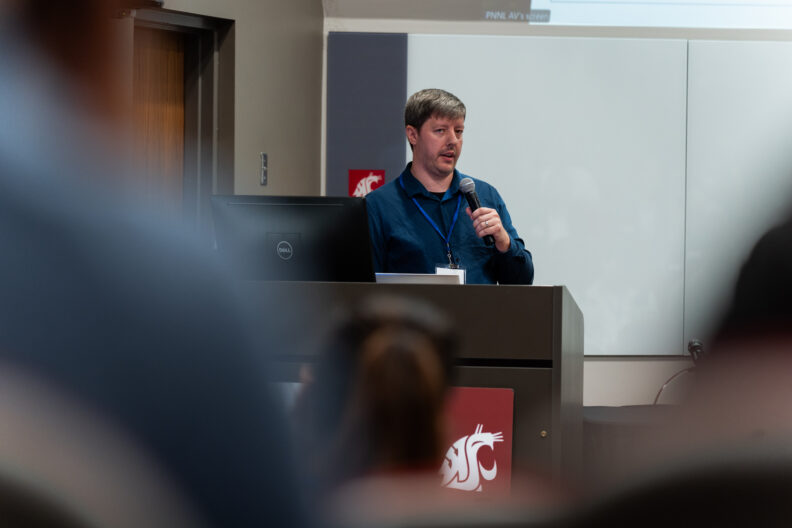
The special topic at this year’s Advanced Grid Institute (AGI) Day was “The Future of Grid Operations” and featured presentations from three researchers: Mark Rice, a group leader of the Energy Systems Resiliency Group at Pacific Northwest National Laboratory (PNNL); Andy Reiman, a power systems engineer from PNNL; and Janna Doppa, a Huie-Rogers Endowed Chair Professor of Computer Science at Washington State University.
Rice presented on the Electricity Infrastructure Operations Center (EIOC) at PNNL-Richland campus, which researchers can simulate a power grid control room using real-world data. The EIOC features a wall of monitors where researchers and utility partners use different data and software to emulate situations that would have an impact on the power grid.
Rice, the capability steward of the EIOC, views the facility as a bridge between researchers, utility companies, and industry partners.
“We focus a lot more on the grid operations in [the EIOC], but in short, especially with researchers, the EIOC is a way for us and people from the government to bring a visceral experience,” Rice said. “For a lot of people, especially when they first start at PNNL, haven’t been in a grid control room. It allows us to find a baseline and to set up, run simulations, and talk about this. It allows us for when DOE comes in and we want to explain a new concept for them to see it, to display it, to walk through how that would lay out in a utility in a way that’s fairly representative.”
The EIOC’s simulations and data allow for users to gain a better understanding of the PNNL’s research, Rice added.
“I still imagine a day of control rooms with operators in them. How can we help them maintain situational awareness, how can we help them maintain sharpness? To make sure that they’re up to date on what’s going to happen, how it’s going to behave, when they need to hit the stop button and start driving the grid again,” Rice said. “This is part of what the EIOC enables us to do, to look at these advancements in AI and then take that and bring that against operators and go ‘Okay how do we make sure that when the event is outside of what the AI can do in way of inference we have the operators in there to make decisions, to make the hard decisions that we can’t leave up to the AI itself?’”
Reiman’s presentation, titled “Adaptive AI Agents (AAIA) for Grid Control Room Operations,” highlighted the role that Super Intelligence might play in power grid control rooms, including AI agents offering recommendations to control room staff.
The AAIA project includes three major components: using data from new and existing sources to improve the skills of both operator and AI agents, reviewing the security- and efficiency-related recommendations from the AI agent, and studying how the control room operator interacts with the AI agent.
“Each AI agent has a different role,” Reiman said.
“The security sentinel recommends agents that effectively maximize security. This goes above and beyond what we would do to maintain ‘N minus one’ contingency security constraints, which is a common practice required today.” Reiman continued, “The efficiency recommender meanwhile recommends actions that improve the operative efficiency or in this case as we’ve implemented it, the operating cost of the grid, and the efficiency recommender’s responsibility is to make recommendations that don’t consider above and beyond security.”
Both of the AI agents provide multiple angles of procedure to the control room operators, who then make a decision on which path to follow.
“The vision for this project is agentic AI agents supporting control room operations. We envision these agents being able to start at rung number one, and then as we derisk and figure out which methods and techniques are appropriate and secure, we can move up the ladder as time goes on,” Reiman said.
Doppa’s presentation also focused on the integration of an AI agent into grid operations. She focused on how AI agents could use training data to make decisions during control room operations.
“We are interested in building this grid co-pilot system for energy management systems where there is an AI module that looks at the current state and suggests what kinds of actions the human operator should be taking,” Doppa said. “The human operator would look at those decisions and eventually would take either one of the decisions or decide to take something else and we use that feedback to continually improve this co-pilot system, and we would be using both digital simulations and the real-world data to continually improve this AI system.”
With both joint institutions working on the integration of AI into the power grid, AGI lays strong groundwork for the future of AI-grid collaboration research.
Recordings of the topics are available on YouTube
Future of Grid Operations:
https://www.youtube.com/watch?v=jpg2-K4xzqA
Adaptive AI Agents for Grid Control Room Operations:
https://www.youtube.com/watch?v=QeWgo2Kdnzo
Use Inspired AI Advances for Trustworthy Grid Decision Support:
https://www.youtube.com/watch?v=WtWkSklp194