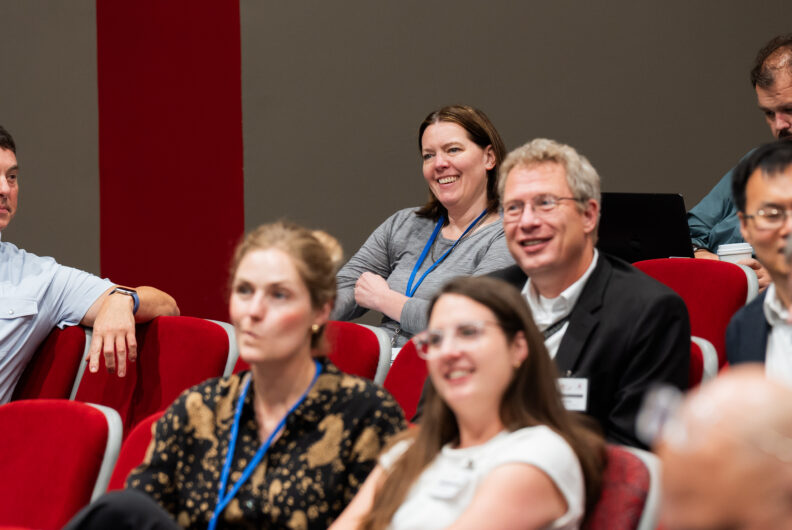
The Washington State University (WSU) – Pacific Northwest National Laboratory (PNNL) Advanced Grid Institute (AGI) hosted its annual AGI Day August 19, 2026, on the WSU Tri-Cities campus in Richland, Washington. This annual event brings together researchers from academia, national laboratories, utility companies, and more to discuss the important issues facing our nation’s power grid.
The overarching theme for AGI Day 2026 was “Intelligent Grids at Scale: Serving Rapid Demand Growth while Preserving Reliability and Affordability. Innovating planning, operations, and resilience in the power grid.”
The agenda focused on the relationship between Super Intelligence (SI) and the power grid, including conversation on data centers. Topics included PNNL’s research on how to improve the efficiency of energy and water use in SI data centers and the different ways in which SI can support power grid control room operators. AGI’s co-directors, PNNL electrical engineer Jeff Dagle and WSU Professor Anamika Dubey, created the agenda.
Retired senior utility executive Larry Bekkedahl delivered the keynote speech, which was followed by talks on grid research visions of both WSU and PNNL.
Next, the audience heard from Jim Ogle, the director of the Electricity Infrastructure Sector at PNNL and Anjan Bose, regents professor and distinguished professor of power engineering at WSU. Ogle spoke about the energy system security while Bose presented on the power program and Energy Systems Innovation Center at WSU.
Ogle described PNNL’s main portfolio of research, namely the delivery of reliable, safe, and affordable electricity to ensure the correct supply to match load.
“First and foremost, we have to make sure that we have the right supply and the right generation to match the loads,” Ogle said. “The way the grid works, that must be done instantaneously all the time, and right now we’re in a place where those two sides of the equations are not being forecasted to line up. What we do is look at the leading-edge kind of technologies. What are the touch system integration problems we can tackle so that the federal government can help support regions and industry to go out there and help increase that capacity?”
The first panel session of the event was SI related, with Anjan Bose moderating a discussion between Bruce Walker, Robert Echenrode, and Uzma Siddiqi about the relationship between SI and the grid.
The special topic session focused on the future of grid operations, featuring presentations by Mark Rice, Andy Reiman, and Jana Doppa, who discussed different ways that SI can be integrated into the control rooms of the power grid.
Later in the day, former AGI Industry Advisory Board members Uzma Siddiqi, John Gibson, and Larry Bekkedahl were recognized for their service to the institute.
Former AGI co-Director and current Director of the WSU Tri-Cities Institute for Northwest Energy Futures (INEF) Noel Schulz presented on the institute’s work with Small Modular Reactors and the Reactor Ready program.
“One of the things that the legislature supported was looking at energy as a system. It’s easy to use small modular reactors, the grid, and large loads [as an analogy for an energy system]. That’s really what INEF is about, and as we start to look at energy as a system, a big area is the food-energy-water nexus, biofuels, and the power grid, including hydrogen, fusion, and fission,” Schulz said.
WSU and PNNL researchers then presented research highlights, with topics ranging from data centers (from PNNL’s Srinivas Katipamula and Shuchismita Biswas) to wildfire modeling (from WSU’s Anamika Dubey and Ji Yun Lee.)
Former AGI co-Director Wei Du presented on his work at PNNL and his new role as an associate professor at WSU. Du described his vision as a joint appointee to bring the best of both institutions to his research.
“I want to keep doing this industry standard model development for grid stability analysis, grid forming, HVDC, geothermal, and small modular reactors. If we can make some success, I think that’s really meaningful for industry. On the WSU side I want to focus on the technology innovation and education, and there are a lot of innovations that we should explore,” Du said. “I really want to add explorative theory of power electronics and machine list power systems, power electronics controls, protection code design, and even hardware platform building. I’m also a fellow of INEF; I really want to work with other INEF fellows to find opportunities to work together.”
Jacob Reidt of PNNL then presented on the Center for Reliable Electricity Delivery, known as GridCRED.
“Fundamentally, what [GridCRED] is attempting to do is build up a governed secure data repository so that we can ease the burden for people to share data with the people who know what to do with it in terms of collecting models, which leads to insight,” Reidt said.
The day ended with a roundtable discussion, moderated by AGI industry engagement advisor Xiaoli Duan, with Eleanor Ewry, Prabu Muthu, Brad Heilman, William Rambo, and Michael Schleich.
The event was followed by a reception at the WSU Tri-Cities Wine Science Center, where researchers and students presented research posters.
AGI Day 2026 helped to bridge the gap between industry, utility, the national laboratory setting, and academia to bring some of the top minds in the field together to network, present their research, and talk about the future directions of some key technological advancements.