Grid reliability is at the core of the Advanced Grid Institute’s (AGI) mission to lead the way in the nation’s demand for reliable power systems. Severe weather events such as wildfire, hurricanes, and earthquakes have the potential to damage power grid infrastructure.
Jason Fuller, an AGI-affiliated researcher and principal research engineer at Pacific Northwest National Laboratory (PNNL), and Charlotte Wertz, a Distinguished Graduate Research Program (DGRP) student at Washington State University (WSU), are working to help bolster power grid stability through research jointly conducted at WSU and PNNL.
Wertz is in her third year of the electrical engineering PhD program at WSU. Through the DGRP program, she is conducting research with Fuller, her PhD co-advisor through the program.
“I got my undergraduate degree in electrical engineering at WSU with an emphasis in power systems and had some really positive experiences during that time that I think have shaped my research interests,” said Wertz. “I had some internships in industry; I worked for a construction contractor first and then went more into the power system side of things where I got to have a government internship working in energy regulation. Then I interned at PNNL, which brought me into DGRP.”
Fuller took a different route than Wertz into electrical engineering, earning an undergraduate degree in physics from the University of Washington, then enrolling for a master’s program at WSU.
“I think electrical engineering or mechanical or other engineering areas feels a bit more near term in terms of ‘I could see some impact, I could see some changes, I could see that’s going out and working,’” said Fuller. “There’s probably at least a subset of us that get really attracted to that.”
During his education at WSU, Fuller met an adjunct professor who was also with PNNL and was offered an internship at the national lab.
“That’s where I discovered ‘Oh this is exciting; this is really great stuff,’” Fuller said. “There were new opportunities right at the time I was getting started, about 2008/2009. The system was rapidly changing, and I had the opportunity at a national lab to impact that.”
Wertz and Fuller connected through DGRP. After conducting undergraduate research with Anamika Dubey, AGI Co-Director and WSU associate professor of electrical engineering, Wertz continued into graduate school being advised by Dubey and became jointly advised by Fuller after starting with DGRP.
Wertz’s work in grid stability focuses on the quantification of severe weather events and the different ways to make that data and the insights interpretable for the utility companies.
“I’m really interested in analyzing the impacts at the community level and developing solutions that help people,” Wertz said. “I think that’s where my passion comes from, seeing a direct pipeline to positive community impact.”
A major factor in grid stability lies in collaboration amongst experts from different backgrounds, not necessarily energy related, working together to find solutions to complex problems.
“The biggest, hardest challenges are those that require subject matter experts from different fields to work together,” Fuller said. “That’s where a lot of these problems are today, where you think ‘I could probably pull up this hurricane simulator, but my understanding is probably too simple to actually matter to the power system,’ what I need is a subject matter expert in hurricane analysis.”
Fuller explained that his work includes bringing together schools of thought from different subject matters to help understand how stability impacts more than just power systems.
“If we have an outage on the natural gas network because of a storm, well, that’s really going to affect my power grid, right?” Fuller said. “Because a lot of our electricity is coming from natural gas or the fact that if I lose electricity, maybe my water treatment plant is no longer operating or only has three days to operate with its backup diesel generator. The things that get me excited about the research and development that we do is really being able to look at this not just as a single kind of contained problem, but because of the nature of the power grid and how it’s tied to so much in our lives.”
Grid stability is extremely complex, and power outages can cause system-wide issues. It’s important to also consider the people those grid disruptions would impact.
“There are always going to be inherent trade-offs,” Wertz said. “It’s always going to be a ‘higher cost and better system, or cheaper and not-as-good system problem.’ I think when people know that, it’s very easy for them to say ‘I’m okay with a couple hours of power outage every year if it means my electric bill is lower.’ But the problem with that mindset is that you’re not taking into account every person’s situation. Someone who’s diabetic and relies on insulin that they have to keep in the freezer doesn’t have the same luxury to say that they’re willing to deal with a few hours of a power outage every once in a while.”
Fuller explained there is a natural balance of affordability to consumers, societal benefits, legislative goals, and regulations that occur when considering power systems, and they take thoughtful consideration by the engineers working to solve the problem.
One of the main threats to grid stability in the Pacific Northwest lies in severe weather events, which can disrupt the operations of power systems. Because the utility companies here vary in size and structure, it takes coordination to ensure that power comes back on after such events.
“We see a lot of extreme winds, atmospheric rivers, wildfires, and since we have such thick vegetation, things like wildfire and extreme wind can be very impactful,” Wertz said. “I would say one way that the Pacific Northwest power system differs from the rest of the country is just how diverse it is, in the sense that we have investor-owned utilities here, we have really small public co-op utilities, we have larger public utilities, and then we also have a large federal power and transmission system through Bonneville Power Administration. When a major event happens, these entities have to coordinate the damage assessment and restoration processes.”
A major part of increasing grid resiliency is figuring out the best ways to mitigate the risks that come along with extreme weather and other hazards. As previously mentioned, Wertz’s research aims to help quantify weather events on the grid, but without a true standardized metric for resiliency, that can be hard to do.
“This is where resiliency differs from reliability, where power system reliability is kind of your day-to-day operation issues and you might have a five-minute power outage or flashing lights or things like that,” Wertz said. “We have metrics to measure how reliable a system is. Resiliency is more of a question mark in the sense that there are a lot of proposed metrics, but not one single one that is widely accepted. It’s relatively more complicated to develop a resiliency metric because they’re such rare events, so we don’t have the same amount of data to model and quantify the impacts. We need to have a metric before we can go and say, ‘This is the best for improving our resiliency.’ That’s what I’m hoping to do.”
Fuller explained the role that researchers play in grid reliability, specifically that researchers themselves don’t control the power grid, rather they inform utility companies on best alternatives and investments the companies could make.
“We’re what we call a Federally Funded Research and Development Center, which means that we work very closely with the Department of Energy to help them understand where their investments, both in terms of research and infrastructure, matter the most,” Fuller said, “a lot of what we do is inform and educate. Rather than say, actually string up a transmissions line ourselves.”
Keeping the power on during severe weather is another important challenge that AGI focuses on. There are several strategies and modern technologies that help the grid weather the storm, but these technologies aren’t always enough during especially turbulent events.
“Sometimes outages are inevitable if a weather event is too extreme, and in that case, it’s about mitigating the total impact and having the best, and fastest, response,” Wertz said.
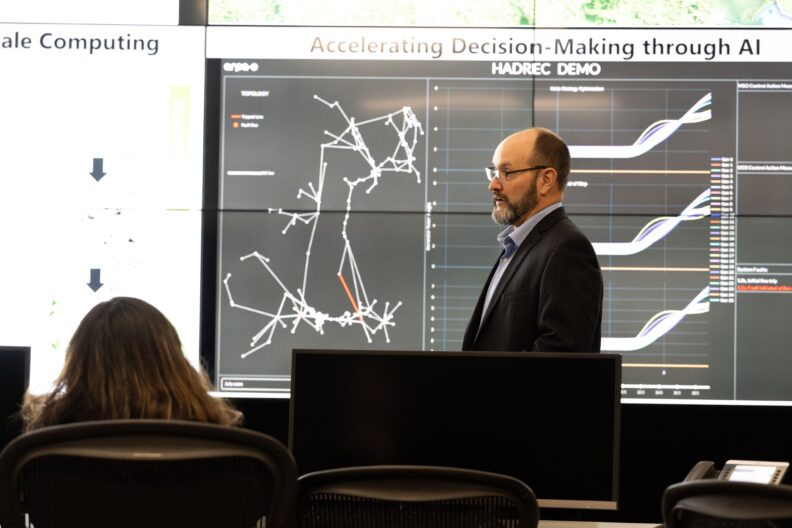
The evolving technology in the power systems space has some exciting prospects that can help with efficiency of data processing and restoration after severe events. “I think one of the big ones right now is we are getting sensors on the system like never before, which means we have far more data and information,” Fuller said. “Now the question is, ‘How do you process and use that information to make a decision?’, ‘How do you inject things like AI decision making or AI supported decisions?’”
AGI helps facilitate this kind of research with the collaboration between a National Laboratory and a university, both bringing their own strengths.
“I think there’s a real value in things like national labs or other kind of more professional environments working closely with universities under something like the Advanced Grid Institute to expand our research portfolio and bring in new ideas and get a pipeline of new ideas into more near-term solutions,” Fuller said.