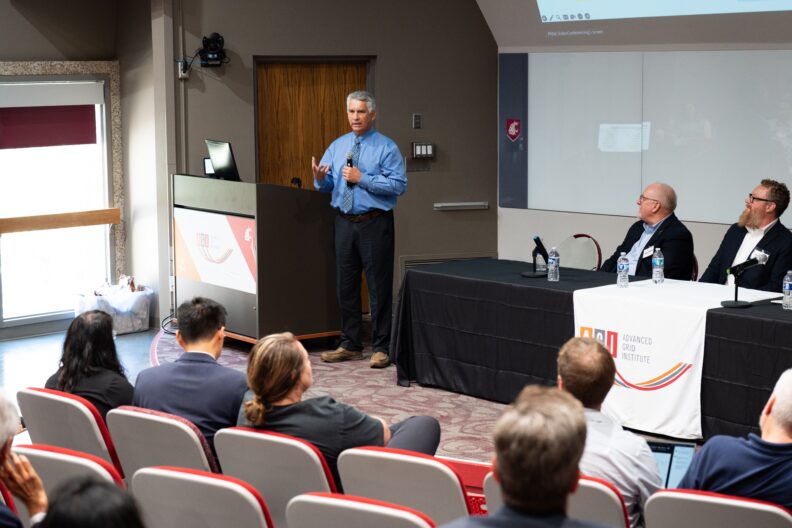
The special topic of Advanced Grid Institute (AGI) Day 2025 was “Wildfire Challenges and Mitigation Strategies.” The panel was hosted by Larry Bekkedahl, Senior VP of Advanced Energy Delivery at Portland General Electric; Andre Coleman, data scientist at Pacific Northwest National Laboratory (PNNL); Kelly Miller, Wildfire Mitigation Program Manager at the Bonneville Power Administration (BPA); and Brad Heilman of Schweitzer Engineering Laboratory.
Bekkedahl opened the panel with the fact that the United States had 3.8 million acres burned as of the presentation being given, which is less than the previous year, but still a significant number.
Emphasizing the danger that wildfires pose to people, property, structures, and utility companies, Bekkedahl gave several examples of large fires the past several years, including the 2020 Mt. Hood fire, the 2023 Maui fire, and the 2025 Los Angeles fire.
“We’re thinking about response, we think about planning, execution, we’re now all going into mitigation plans,” Bekkedahl said, “We’re required under regulation to have a plan each year, put that in place and act on it.”
Bekkedahl mentioned multiple factors that go into mitigation plans, such as hardening the system, managing vegetation around the power systems, and Maintaining awareness of local conditions.
He also described a new practice being utilized by utility companies is using cameras equipped with AI and putting them in woody areas to detect smoke and fires potentially hours before they got big enough to detect otherwise.
Part of running a utility company is managing outages is to ensure that the power is shut off when it’s unsafe to have certain wires electrified because of tree branch coverage or similar hazards.
“Other things to mention: early fault detection,” Bekkedahl said. “There are devices that are sensing and looking for signal signatures that would tell you that you’ve got a cracked insulator on the line, or you’ve got a conductor that’s split.”
Coleman and Miller were the next presenters, presenting jointly on wildfire challenges and grid resilience from the perspective of the PNNL and BPA.
“Every region in the country is seeing an increase in fire occurrence, this used to be a western issue… anywhere from doubling to twelvefold increases in occurrence,” Coleman said. “This has become a national problem.”
Coleman then detailed a partnership between PNNL and BPA, highlighting that PNNL develops a map with potential burn probability areas in the region.
“Typically we’re doing this very early in the year, from November to January in the peak fire season,” Coleman said. “Then we go back after the fires have occurred that year and say ‘How did the model do? What was our predictive capability?’ By and large we’re seeing where fire occurs in places where we generally expect fire to occur. However, we’re seeing this emerging pattern too where we’re seeing a lot of fire starting to occur in places where historically it’s been very, very low probabilities.”
One of the regions with these low probability fires is the west slope of the Cascade Mountains, and Coleman said one of the concerns with this is the amount of biomass and fuels on the mountain.
Miller presented next, beginning her talk with wildfire resiliency within BPA and beyond.
“The base of everything is making sure our system is up and functioning the best it can, that’s looking at regular system hardening – so upgrades as planned, regular maintenance to both assets and vegetation,” Miller said. “On top of that is situational awareness and a big piece of that is working with our partners at PNNL to provide wildfire risk models and meteorologists on staff that work closely with us through ‘quote unquote’ wildfire season – there’s no dates on that, but also throughout the year to alert us of any weather that could be coming in or forecasted that could harm our system.”
Miller said that as of August 20th, BPA has not had to conduct a public safety power shut off or deenergize any power lines. She also said that BPA is looking to use new technology to continue to mitigate fires.
“A couple highlights we have within our program is first vegetation management,” Miller said. “That is at the very core of how we attempt to be as safe as possible. We only have the ability to control within our right of ways that we have legal rights to. So vegetation outside our right of way is a huge risk for us for falling into the lines, into structures, into assets in general and could spark a fire. We actively work with the Forest Service in multiple regions to determine needs not just next to and adjacent to our right of ways, but in the forest surrounding them.”
Highlighting the importance of collaboration, Miller said that working with local and international partners helps gain and share information between entities to ensure safety moving forward.
Heilman was the final presenter of the panel and spoke on power transmission.
“Some of the other things I’m trying to do a better job with helping, is explaining fully how the technology is going to work really well,” said Heilman. “Right now, I feel there’s a bit of urgency. I want to be there to have a conversation to say, ‘Let’s just think about it,’ because I’ve seen some folks make some mistakes with expectations.”
This panel highlighted the urgency of maintaining safety standards while investigating and innovating new solutions to approach the problem of potential fire hazards and the best ways to keep people and the power grid safe.
For more information, watch the full panel recording.