AGI Workshop on Power Systems Research Needs and AI/ML Innovation
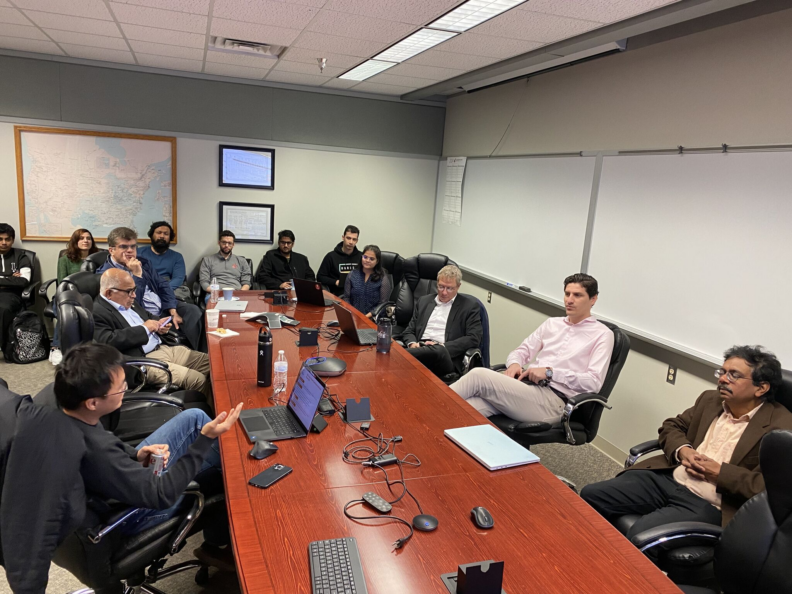
AGI hosted a half-day workshop at Washington State University (WSU) to convene experts from diverse fields—power systems, machine learning, advanced analytics, applied mathematics, Earth systems science, risk modeling, and economics. The goal was to identify critical research gaps in grid science that could be addressed through interdisciplinary collaboration, especially at the intersection of power systems and AI/ML.
A central theme was the growing need to shift from deterministic to probabilistic approaches in power system modeling and analysis. Traditional methods such as economic dispatch, optimal power flow, and contingency analysis (e.g., N-1 or N-1-1) operate under deterministic assumptions, primarily for their simplicity and computational efficiency. However, these assumptions are increasingly challenged by the realities of a changing grid—marked by the variability introduced through electrification, unexpected events, and evolving policy and technology landscapes. The group emphasized that capturing these uncertainties will require scalable, probabilistic frameworks that can inform both planning and real-time decision-making.
The workshop also explored key AI/ML and analytics research directions that align with power system needs:
- Uncertainty Quantification: There is a need for advanced methods that characterize different classes of uncertainty and their sensitivities, especially to inform decision-making under risk and enable tailored mitigation strategies for issues like faults or cybersecurity threats.
- Scalable Modeling: As power systems grow more complex and data-rich, scalable, hierarchical, and distributed modeling approaches become essential, particularly those that can incorporate localized models into system-level studies and support decentralized uncertainty management.
- Multi-Objective Decision-Making: Designing and operating power systems involves balancing multiple competing objectives. New analytical frameworks are needed to explicitly incorporate trade-offs and risk evaluations in system planning and operation.
- Learning-Based Optimization: Optimization under uncertainty remains a computational bottleneck. Learning-to-optimize and control approaches offer promise, but require tight safety, performance, and stability guarantees—especially for critical infrastructure like the grid.
- Explainability in AI/ML: Trust in AI/ML models is a major barrier to adoption. The group emphasized the importance of explainable models that provide actionable insights for human operators and clarify when models may fail or behave unsafely.
The workshop concluded with a discussion on building meaningful collaboration between WSU and PNNL. Participants emphasized the importance of identifying specific grid use cases that align with institutional strengths, forming interdisciplinary teams to pursue focused research thrusts, and engaging in collaborative opportunities such as joint proposals or hackathon-style events. Looking ahead, the group expressed interest in launching a longer-term initiative focused on probabilistic methods for power systems, potentially through a center-level proposal that could serve as a hub for innovation at the intersection of grid science and AI.
In summary, the workshop highlighted both the urgency and opportunity in rethinking power systems research through an interdisciplinary lens, leveraging the strengths of AI/ML and advanced analytics to build a more resilient, intelligent, and adaptive grid.