AGI Day—Gathering for a Future Clean Energy Grid
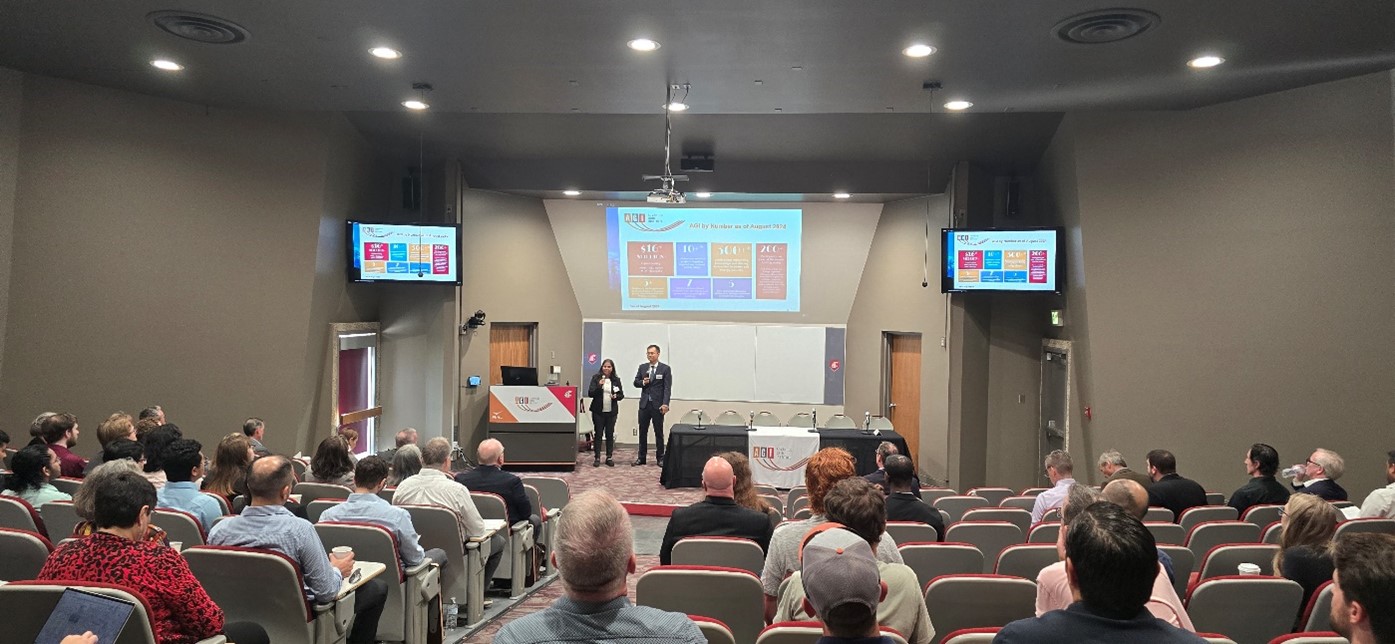
The future of the electric grid relies on the passion of researchers, educators, industry, and students as the next-generation workforce to address complex problems like decarbonization, security, resilience, and flexibility.
“The question is what are we as a research community, industry, and stakeholders going to do to solve it?” said Pacific Northwest National Laboratory (PNNL) Associate Director Jud Virden on Advanced Grid Institute (AGI) Day, regarding the challenges of the evolving grid.
AGI—a joint institute of PNNL and Washington State University (WSU)—welcomed over 100 in-person and online attendees to AGI Day, hosted in Richland, WA, to address not only challenges but also opportunities and solutions. The annual event was themed “Nexus of Power Systems Engineering and Advanced Analytics Toward a Resilient and Decarbonized Grid.”
“AGI’s advanced, national-scale simulation capabilities are needed now more than ever,” said Washington Senator Maria Cantwell in opening remarks delivered by Richard Evans, outreach director for central Washington. “With diverse talent and resources that PNNL, WSU, and this entire joint institute bring together, I know that our state is uniquely equipped to rise to these challenges.”
Codirector Anamika Dubey and Interim Codirector Wei Du opened the morning with an introduction to AGI and the institute’s mission areas.
Keynote speaker Mike Miller, vice president of transmission engineering and technical services at Bonneville Power, called the day inspirational.
“We are trying to find a way to make the invisible visible and prepare for what is coming,” said Miller. “I want to talk about the speed at which we are flying into a future that is difficult to see or prepare for and anticipate.”
Miller talked about the vast technological advancements from 1985 to today—from dial phones to cellphones, and large computers that needed programmed to compact laptops.
“It takes you [in this room] being able to see the invisible future and anticipate it. The clock is ticking,” said Miller.
John Gibson, Avista Innovation Lab director and chief research and development engineer, introduced the Inland Northwest Center for Energy and Decarbonization (INTENT), funded by the National Science Foundation’s Engines Development Award. INTENT aims to address the social, economic, and environmental impacts of the power grid and lead the transition to clean energy.
AGI Day attendees learned about an upcoming regional study on valuing distributed solar for Washington State, presented by Donna Gerardi Riordan from the Washington State Academy of Sciences.
Attendees also took a deep dive into the PNNL and WSU research portfolios and highlights, including the following:
· Overview of the Electricity Infrastructure Sector and the Earth and Systems Science Division at PNNL
· Overview of the Institute for Northwest Energy Futures and Energy Systems Innovation Center at WSU
· Research conducted by the PNNL Grid Operations, Decarbonization, Environmental and Energy Equity Platform (GODEEP)
· Outcomes of ongoing efforts from the PNNL Resilience through Data-Driven, Intelligently Designed Control (RD2C) Initiative
· Ongoing WSU research on modeling and coordination of grid-edge resources and a power grid that is dominated by inverter-based resources
The industry advisory board panel spoke to some of the issues the power industry is affected by today, sparking a lively discussion between the board members and audience.
Larry Bekkedahl, senior vice president of advanced energy delivery at Portland General Electric, said, “How do we meet new, large loads? We’re being asked to double loads in some places. It is stunning to think about. And by the way, it has to be affordable to everybody too.”
They also discussed machine learning, wildfire risks, cybersecurity challenges, and recruitment challenges resulting from the shift in workforce.
“We are dependent on institutes like AGI to bring all of the pieces together to help us see the bigger picture,” said Eleanor Ewry, manager of transmission strategy and markets at Puget Sound Energy.
AGI wrapped up with emerging directions in grid research at both WSU and PNNL.
Jacob Reidt, director of the Grid Center for Reliable Electricity Delivery (GridCRED™) at PNNL, introduced GridCRED™, a regional planning platform that addresses a growing need for decision-makers to understand and consider complexities like climate impacts, system behavior, and affordability as the electricity sector is decarbonized.
Du, who also serves as solar subsector manager at PNNL, presented on power electronics for a better grid.
“Most renewable resources and large loads are connected to the grid through power electronics interfaces. One of AGI’s research focuses is to investigate how to better control and operate those power electronics devices to improve the grid stability and resiliency,” said Du.
Assefaw Gebremedhin, associate professor at the WSU School of Electrical Engineering and Computer Science, spoke about grid analytics and cybersecurity research. Alan Love, professor at the WSU School of Economic Sciences, presented energy economics research, and Ji Yun Lee, WSU assistant professor in civil and environmental engineering, presented on resilience, community, and grid connections.
An audience member asked attendees, “how do we keep the momentum up and not just wait for the next AGI Day? We have a chance to do things right.”
Throughout AGI Day, there were opportunities for networking and building connections that expand beyond AGI Day. The partnerships established and being built are essential to the success of AGI’s mission to advance grid-science research and technology and to develop the workforce needed to accelerate the decarbonization and electrification of the power grid, driving transformative changes toward a sustainable future.
“Organizing this year’s AGI Day was an incredible experience. Bringing together industry experts, researchers, students, and regional stakeholders for engaging discussions on innovative solutions to tackle emerging challenges in power and energy systems was truly inspiring,” said Dubey. “Special thanks to the AGI support team for making it a success! I look forward to partnering with Wei on next year’s AGI Day—let’s keep pushing the boundaries of innovation!” If you missed out on AGI Day, watch the recorded sessions here.